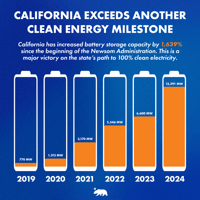

Earlier this week I joined a group of energy experts and state lawmakers at a battery storage site...
Study Highlights Importance of Modern Storage Safety Standards
Two recent articles in SFGATE and The Mercury News covered a new study in Scientific Reports on the January 2025 Moss Landing battery fire that estimates roughly 55,000 pounds of metal particulates were dispersed across nearby marshland. However, the study does not assert that the reported quantities produced harmful health or environmental effects. While the findings underscore the scale of the incident, California’s storage industry has already moved toward safer container-based system designs. As CESA Executive Director Scott Murtishaw explained in the Mercury News article, “The largest fire I am aware of at a container-based facility was less than 2 percent of the size of the Moss Landing fire. So, we should never see that level of emissions from future incidents.”
For policymakers, the study reinforces the importance of modern safety standards, improved system architecture, and rigorous oversight, not a slowdown in energy storage deployment. With hundreds of new projects in the pipeline, CESA continues to emphasize that the path forward is safer technology, updated regulations, and community-focused siting that maintains public confidence while supporting the state’s clean energy transition.
Additional Context from CESA
CESA Executive Director Scott Murtishaw provided additional comments to The Mercury Times reporter that were not included in the published article. His remarks offer important context about how today’s storage systems differ from the building-scale design involved in the Moss Landing incident.
“While this study provides interesting findings, it does not apply to the energy storage systems currently planned and under development. California adopted new energy storage construction standards this year, and current practices both reduce the likelihood of fires and substantially reduce their size if they do occur. Energy storage facilities built today use an outdoor container-based design that inherently limits the spread of fire from one unit to another. The largest fire I am aware of at a container-based facility was less than 2 percent of the size of the Moss Landing fire, so we should never see that level of emissions from future incidents.”
Scott also noted that the study describes the metal deposition as “thin, transient and patchy,” and the authors do not assert that the detected concentrations represent an ecological or public health hazard. Surface levels diminished quickly due to rain and tidal action.